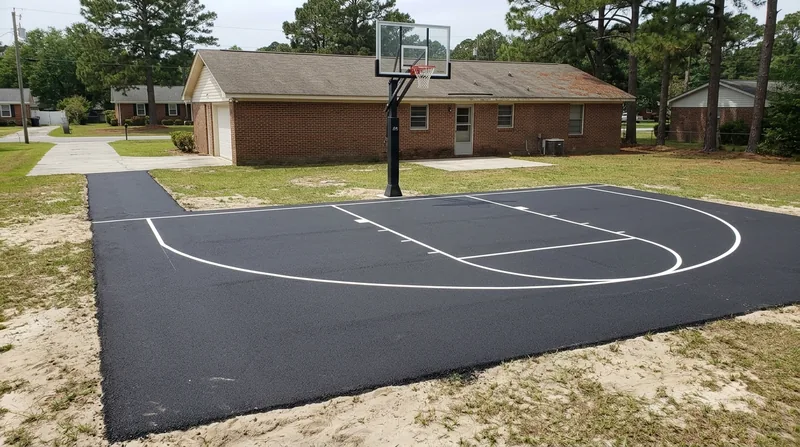




A basketball court, tennis court, or recreational path in Jacksonville has to handle Onslow County's punishing weather. With 54 inches of rain per year concentrated in hurricane season, and sandy coastal soil that drains well on higher ground but turns soft near the creeks and marsh drainage that cuts through the flat terrain, a court built without proper grading and base compaction will settle unevenly, crack, and trap water after every downpour. Sports Court & Path Paving in Jacksonville means grading the site correctly, compacting an aggregate base to shed water fast, and finishing with hot mix asphalt that stays flat and playable through the summer and fall storms that break cheaper installations. We grade, compact, and finish with precision so your court or path performs through the season.
Why Sports Court & Path Paving Matters in Jacksonville's Climate
Jacksonville's sandy and loamy coastal plain soil drains well on higher elevations, but the flat terrain around Camp Lejeune and the newer subdivisions spreading toward Carteret, Duplin, and Craven counties includes low spots where water collects after storms. A court or path poured without attention to pitch and base preparation will hold water, crack under freeze-thaw stress (though frost stays shallow here at roughly 12 inches), and fail fastest under the weight and abrasion of seasonal use combined with heavy rainfall. The real failure mode in Jacksonville is not winter freeze-thaw but hurricane season saturation: water finds every weak spot in a loose base, washes out the support, and the surface breaks apart in alligator cracking or settling. Proper grading, compaction, and pitch solve this problem before it starts.
- We grade the site to shed water away from the court or path, preventing pooling and saturation of the base.
- We compact the aggregate base in lifts to support the asphalt through Jacksonville's heavy summer and fall downpours.
- We finish with hot mix asphalt laid at the correct pitch so water runs off fast and play stays level.
- We verify compaction with proof rolling so the base will not settle or shift under foot traffic and ball impact.
These steps are the difference between a court that holds up for years and one that cracks and fails after the first hurricane season.
Key info: Jacksonville's building department and your HOA (if you are in a master-planned community) may have requirements for impervious-surface limits, stormwater management, and driveway or court apron setbacks. We help you navigate local permitting and design the court to meet those standards. Verify your specific rules with the city before we break ground.
For more detail on how base preparation and drainage affect all asphalt surfaces, see our page on asphalt driveway paving and installation.
How We Build a Sports Court or Path in Jacksonville
A court or path starts with a site walk and measurement. We assess the terrain, the drainage pattern, soil conditions, and any existing utilities or structures. Then we plan the grade, the base thickness, and the finish elevation so water runs off and the court sits stable. The work moves in clear steps: rough grading, base installation and compaction, final grading, and asphalt laying. Throughout, we keep pitch and edge detail in mind so every drop of water moves away from the playing surface and into the storm drains or gravel shoulder.
- We measure the site and assess soil, drainage, and utility locations before quoting or scheduling.
- We rough grade the area to the planned elevation, removing high spots and filling low areas.
- We deliver and spread crushed stone or recycled asphalt base, then compact it in lifts with a vibratory roller.
- We proof roll the compacted base to verify it will support the asphalt and foot traffic without settling.
- We lay hot mix asphalt at the designed thickness and pitch, finishing edges and transitions cleanly.
- We allow the asphalt to cure before the court opens to play, typically 24 to 48 hours in warm weather.
This process ensures the court or path will perform through Jacksonville's wet season and multiple years of use.
Example: A residential basketball court in Jacksonville typically runs 94 feet by 50 feet (half court) or 94 by 94 feet (full court). A half court at 4,700 square feet with 4 inches of asphalt over 6 inches of compacted base, plus proper grading and pitch, will cost more than a simple driveway patch because of the site work and precision required. We quote on site after a walk-through and measurement. See our pricing page for ballpark figures and what affects the final cost.
Methods and Approaches to Court and Path Paving
| Approach | Description | Best for |
|---|---|---|
| New court or path on raw ground | Full site grading, base installation and compaction, asphalt finish in designed thickness and pitch. | New installations where drainage and base must be built from scratch to handle Jacksonville rainfall. |
| Resurfacing an existing court | Milling the old asphalt, inspecting the base for integrity, adding new base if needed, and laying new hot mix. | Courts that are cracked or worn but have a sound base underneath; extends life 10 to 15 years. |
| Overlay on existing asphalt | Lay new hot mix asphalt directly over the existing surface without milling, if base is intact. | Courts with minor surface wear and a solid base; faster and cheaper than milling, but only if base is sound. |
| Full-depth replacement | Remove all asphalt and base, rebuild from soil up with new grading, base, and finish asphalt. | Courts with failed bases, poor drainage, or settlement; ensures a stable platform for 15 to 20 years. |
| Recycled asphalt base | Use reclaimed asphalt millings as the base layer, compacted and sealed with new hot mix on top. | Budget-conscious courts where a solid recycled base will perform well; reduces material cost and waste. |
We assess your existing court or path on site and recommend the method that gives the best performance for your budget and timeline.
Sports Court & Path Paving Cost in Jacksonville: What to Expect
A new recreational court or path in Jacksonville starts at around $8,500 for a small half court (roughly 2,500 to 3,000 square feet) with proper grading and base preparation. A full court or larger path will run higher. The cost depends on the site: existing terrain, soil conditions, drainage needs, base thickness required, and asphalt thickness all move the price. A site with poor drainage or soft soil will need more base material and compaction work. A site with utilities nearby may require careful hand-digging or locates. Access for equipment matters too. A court tucked behind a house or in a narrow lot costs more to build than one on open ground.
We always recommend getting 2 to 3 estimates so you can compare not just price but approach. A low bid that skips base compaction or ignores drainage will fail in Jacksonville's wet season. A thorough estimate will show tonnage of base material, asphalt thickness, and how the site will be graded. Ask any contractor for those details in writing.
Key info: New asphalt must not be sealed for the first six to twelve months while it cures and hardens. Many contractors will push sealcoating as an immediate upsell; ignore that pitch. Seal only after the curing window closes, and only if you choose to. Proper base and pitch will keep the court performing for years without seal.
For a detailed breakdown of pricing by service type and size, visit our full pricing page.
Sports Court & Path Paving Near Me: What to Look For When Hiring a Contractor in Jacksonville
A sports court or path is a significant investment, and the quality of the work depends heavily on the contractor you choose. The most important signal of a trustworthy paving shop is that it is verifiably local: a local address, local phone number, and local equipment. The historic fraud in paving is the itinerant door-to-door crew with out-of-state plates who shows up unsolicited, quotes a price that is too good, asks for a large cash deposit, and leaves behind poor work or unfinished jobs. You protect yourself by working with a contractor who lives and works in Jacksonville and has a reputation in the community.
When you call a contractor, ask for a written estimate that includes the site plan, the thickness of base and asphalt, the tonnage of material, and a timeline. Ask whether the contractor is fully insured and ask to see a certificate of insurance. Ask for references from recent court or path projects in Jacksonville or nearby. If the contractor is evasive about any of those details, move on. Verify that your city or HOA has no special requirements for the court (setbacks, impervious-surface limits, stormwater management) and ask the contractor to help you understand those rules before work starts. North Carolina law requires a utility locate before any excavation, so the contractor must call 811 and have the site marked before breaking ground.
- Get a written estimate with site plan, material tonnage, asphalt and base thickness, and timeline.
- Ask to see proof of insurance and request a certificate naming you as additional insured if required by your HOA.
- Call references from recent court or path projects in Jacksonville to ask about quality, timeline, and cleanup.
- Verify local permitting and HOA rules before committing, and confirm the contractor will help navigate them.
- Confirm the contractor will call 811 for utility locates before any digging or grading begins.
We are fully insured, local to Jacksonville, and happy to provide references, a site walk, and a written estimate at no cost. Call us at (910) 526-0876 or contact us online to schedule.
Sports Court & Path Paving in Jacksonville: Pricing Guide
| Service | Price | Details |
|---|---|---|
| Half court (2,500-3,000 sq ft) | Starting at $8,500 | Includes grading, 6-inch compacted base, 4-inch asphalt finish, and pitch for drainage in Jacksonville soil |
| Full court (4,500-5,000 sq ft) | Starting at $14,500 | Includes full site grading, base compaction, 4-inch asphalt finish, and proper pitch for water runoff |
| Resurfacing existing court | Starting at $6,500 | Includes milling old asphalt, base inspection, new 2-3 inch overlay, assumes base is sound and drains well |
| Recreational path (per 100 linear feet) | Starting at $2,500 | Includes grading, compacted base, asphalt finish, width typically 8-12 feet depending on use |
| Site assessment and estimate | Free | Response within 24 hours at (910) 526-0876, includes measurement, soil walk-through, and written quote |
Indicative pricing, the exact cost depends on square footage, finish, and site access. Free personalized estimate within 24h at (910) 526-0876.


