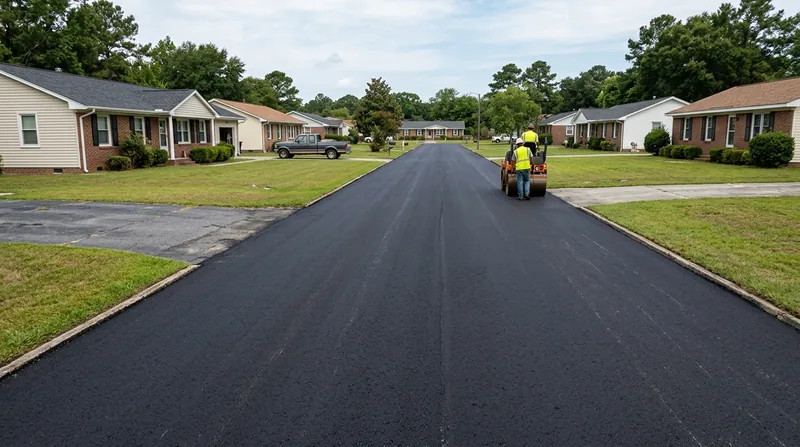




Private Road & HOA Paving in Jacksonville keeps subdivision streets and common-area lanes passable through the heavy rain and steady traffic that define life around Camp Lejeune. The flat, sandy terrain of Onslow County drains reasonably well on higher ground, but hurricane-season downpours find every low spot and soft base, washing out edges and settling pavement unevenly when the job is done wrong. Private roads and HOA streets near Jacksonville need a solid, properly compacted aggregate base, correct pitch to shed water fast, and the right thickness of hot mix to handle daily traffic without rutting or cracking. We grade, compact, and pave in sections sized to fit HOA budgets and the long paving season that runs from March through November. Jacksonville Asphalt Paving has been doing this work locally since 2016, and we know the soil, the weather, and the rules that apply to shared roads in every village across Greater Jacksonville.
Why Private Road & HOA Paving Matters in Jacksonville: Base, Pitch, and Hurricane Season
Private roads and HOA streets carry the same traffic as public roads but without the municipal maintenance budget. In Jacksonville and the surrounding base communities, that means a driveway-width lane can see fifty to a hundred trips a day, and the sandy coastal-plain soil underneath will settle unevenly if the base is not properly compacted or if pitch and edge compaction are skipped to save time. A road that holds water after a summer thunderstorm will fail faster than one that sheds it in minutes. Alligator cracking, edge failures, and ruts appear within two to three years if the base is soft or the surface was laid too thin. A well-built private road, paved with the right thickness over a proof-rolled aggregate base and sloped to drain, lasts ten to fifteen years before an overlay becomes necessary.
- We compact the sandy base to ninety-five percent standard proctor density before any asphalt is laid, using a vibratory roller and proof rolling to verify the foundation.
- We establish proper crown and edge pitch so water runs off the pavement into the shoulders or drainage swales, not into the base.
- We lay the hot mix in lifts sized to the paving width and temperature, with full edge compaction to prevent raveling and water entry at the sides.
- We specify tonnage and thickness on every estimate so you know exactly what is being installed and why it fits the traffic and soil conditions.
A private road built this way stays firm under daily use and handles the 54 inches of annual rainfall that Jacksonville receives without settling or cracking prematurely.
Key info: North Carolina requires a utility locate (call 811 before digging) before any grading or base prep work on a private road. We handle that notification, but the locate request is your legal responsibility as the property owner or HOA board. Check with your local building department and HOA architectural guidelines before we start, as some jurisdictions require a grading or site plan permit.
For more detail on how base preparation affects long-term durability, see our guide to Asphalt Resurfacing & Overlay, which covers when an existing road can be resurfaced and when it needs full-depth replacement.
How We Build a Private Road or HOA Street: Process and Timeline in Jacksonville
Private road paving in Jacksonville follows a straightforward sequence: site survey and measurement, base grading and compaction, asphalt milling if an old surface exists, new hot mix placement, and final compaction. The timeline depends on road length, weather, and whether an existing surface needs removal. A half-mile HOA street can be completed in two to four weeks if weather cooperates and the base is stable. Longer roads or those with poor drainage may take eight to twelve weeks if grading and base work must be staged to avoid trapping water.
- We survey the road length, measure cross-sections, and identify low spots, soft areas, and drainage issues with a site walk and basic level work.
- We notify 811 for utility locates and confirm the locate marks are visible before any excavation or grading begins.
- We grade the subgrade to remove soft material, fill low spots, and establish the correct slope, then compact with a vibratory roller to ninety-five percent density.
- If an old asphalt surface exists, we mill it to a consistent depth or remove it entirely, depending on the base condition and HOA budget.
- We place a compacted aggregate base, typically four to six inches of dense-grade crushed stone, proof-rolled and inspected before paving.
- We lay hot mix asphalt in two lifts, typically 1.5 inches binder and 1.5 inches surface course, with full edge compaction and proper crown for drainage.
- We allow the pavement to cool and cure for 24 to 48 hours before opening to traffic, and do not apply seal coat during the first six to twelve months of cure.
This sequence ensures that the road is built on a solid foundation and sheds water correctly from day one.
Local example: A half-mile HOA street in Piney Green with a failing sandy base and standing water after heavy rain typically requires two weeks of grading and base work, then one week of paving. Total cost runs from $18,000 to $24,000 depending on how much soft material must be excavated and replaced. We break the work into two phases if the HOA budget requires it, completing drainage and base prep in spring and paving in early summer.
For details on how we handle existing pavement and the choice between full replacement and overlay, visit our page on Asphalt Milling & Removal.
Private Road & HOA Paving Methods: Choosing the Right Approach
The right method depends on the condition of the existing surface, the traffic load, the soil underneath, and the HOA budget. A road with a solid base and surface wear only is a candidate for overlay; a road with alligator cracking, rutting, or a soft base needs full-depth replacement. We evaluate both options on site and recommend the approach that delivers the best durability for the money.
| Approach | Description | Best for |
|---|---|---|
| Overlay (Resurfacing) | New hot mix asphalt laid over the existing surface without removal. Typically 1.5 to 2 inches of binder and surface course. | Roads with a stable base, minor cracking, and no rutting deeper than half an inch. Saves cost and time. |
| Mill and Overlay | Existing asphalt is milled to a depth of 1.5 to 2 inches, then new hot mix is laid on the milled surface. | Roads with surface distress, rutting, or moderate cracking, but a solid base underneath. Maintains drainage and removes problem asphalt. |
| Full-Depth Replacement | Complete removal of old asphalt and base, site grading, new compacted aggregate base, and new hot mix asphalt in two lifts. | Roads with alligator cracking, soft or failing base, poor drainage, or standing water. Solves structural problems and extends pavement life. |
| Recycled Asphalt or Tar and Chip | Recycled asphalt millings compacted over a graded base, or tar and chip (asphalt binder and stone chips compacted together). | Low-traffic private lanes, rural HOA roads, or budget-conscious HOAs. Lower upfront cost, requires regular maintenance and occasional re-chipping. |
We evaluate the road on site, take core samples if needed, and recommend the method that fits the traffic, the soil, the budget, and the HOA's long-term maintenance plan.
Private Road & HOA Paving Cost in Jacksonville: What to Expect
Private road and HOA street paving costs depend on the road length, the width, the condition of the base, whether an existing surface must be removed, and the method chosen. A half-mile of new or replacement paving typically runs from $15,000 to $30,000 or more, depending on grading scope and base work. An overlay on an existing stable road costs less, typically $8,000 to $15,000 per half-mile. A longer road or one with extensive base repair will cost more. The only way to know the exact figure for your HOA is to get a site estimate with tonnage and thickness specifications.
Factors that move the cost up include:
- Extensive grading and excavation needed to remove soft or saturated soil and rebuild the base.
- Milling and removal of an existing asphalt surface, which adds labor and disposal cost.
- Road length and width, which determine total tonnage and labor hours.
- Drainage work, such as installing or repairing swales, culverts, or edge drainage to prevent water from pooling.
- Phased construction, where work is staged over multiple seasons to spread HOA expense or avoid disrupting the community.
For detailed pricing on all our services and to understand what drives cost in your specific situation, visit our full pricing overview. Call us at (910) 526-0876 for a free estimate with written tonnage and thickness specifications.
What to Look for When Hiring an Asphalt Paving Contractor Near Me in Jacksonville
The strongest signal that a paving contractor is local and trustworthy is a verifiable Jacksonville address, local phone number, and a history of work in the community. Avoid unsolicited door-to-door offers, crews with out-of-state plates, and any bid that skips tonnage and thickness specifications. A real estimate includes the road length, the thickness of asphalt and base, the tonnage of material, and the method being used. Ask for references from other HOA boards or private roads in Jacksonville or nearby towns, and call at least two of them.
When comparing estimates, check these details:
- The estimate lists road length, width, thickness of asphalt (typically two lifts totaling three to four inches), and tonnage per mile or per square foot.
- The contractor explains the base condition and recommends overlay, mill and overlay, or full-depth replacement with specific reasons.
- The contractor confirms that a utility locate (811) will be called before any grading or excavation begins.
- The contractor verifies that your HOA architectural guidelines and local building department permit requirements have been reviewed and will be followed.
- The estimate is provided in writing with a start date, completion timeline, and payment terms clearly stated.
A contractor who answers your questions clearly, provides references, and explains the work in plain language is far more likely to deliver a road that lasts than one who rushes through the estimate or pressures you to decide immediately. For a free, no-obligation estimate from Jacksonville Asphalt Paving, contact us today. We respond within 24 hours and include full tonnage and thickness specifications on every quote.
Private Road & HOA Paving in Jacksonville: Pricing Guide
| Service | Price | Details |
|---|---|---|
| Private road or HOA street overlay | Starting at $8,000 | New asphalt over existing stable surface, half-mile typical, depends on width and condition |
| Mill and overlay | Starting at $12,000 | Existing asphalt milled and removed, new surface laid, half-mile typical, base condition determines final cost |
| Full-depth replacement with grading | Starting at $15,000 | Complete removal, base rebuild, and new asphalt, half-mile typical, soft soil or drainage issues add cost |
| Longer roads or complex grading | On estimate | Mileage, base condition, utility conflicts, and phasing options require site evaluation before pricing |
| Travel and site visit | Included | No separate charge for travel within Jacksonville and surrounding Onslow, Carteret, and Craven County areas |
| Free written estimate | No obligation | Response within 24 hours with tonnage, thickness, and method clearly specified, call (910) 526-0876 |
Indicative pricing, the exact cost depends on square footage, finish, and site access. Free personalized estimate within 24h at (910) 526-0876.


